

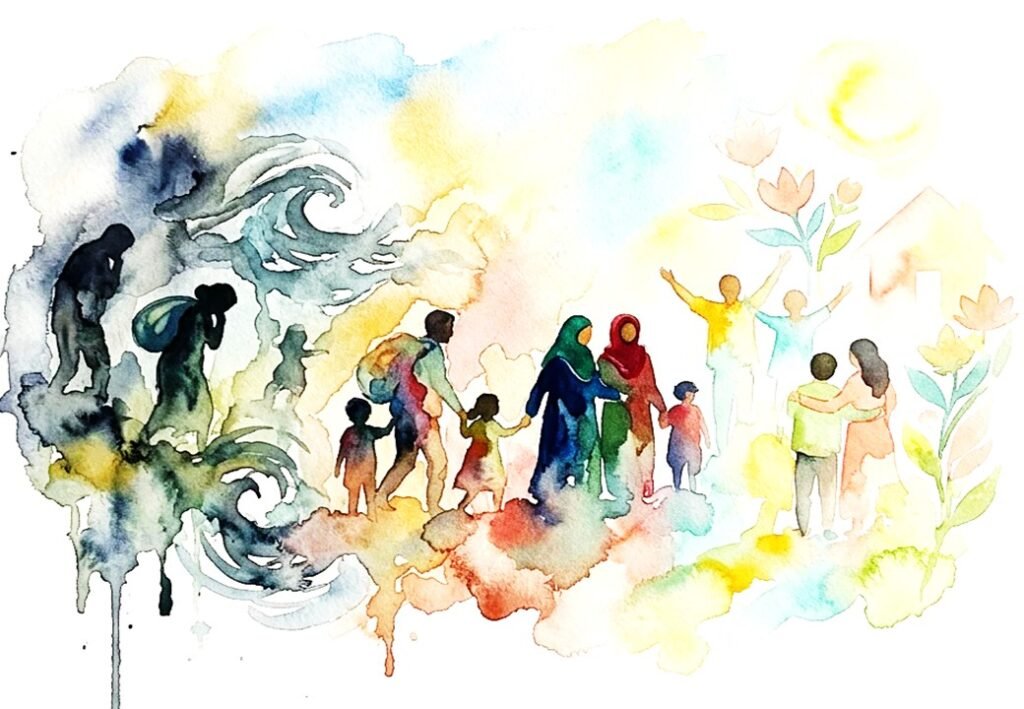
Migration and Integration
Policies that safeguard equal rights, social participation/recognition, and cultural continuity are essential for fostering migrants’ social resilience and enabling integration as a process of belonging rather than normative absorption
Migration and integration form a dynamic social process shaped by movement, disruption, and the search for belonging. Migration emerges not only as relocation but as a profound transition marked by uncertainty, shifting identities, and encounters with new political, cultural, and social environments. Integration, meanwhile, is revealed as neither a linear pathway nor a uniform expectation or outcome. It oscillates between assimilationist pressures (melting down into dominant norms) and relational, reciprocal models that value diversity, social connection, and shared participation. Social resilience becomes the bridge between these experiences: migrants navigate status, networks, support, and visibility while learning to “bounce ahead” in unfamiliar contexts. Putting together integration is most meaningful when grounded in lived experience, when migrants are recognized as beings rather than becomings, and when host societies cultivate spaces for interaction, reciprocity, and co‑existence. People, places, and practices contribute to give meaning to integration by shaping how individuals and groups understand belonging, participation, and coexistence.
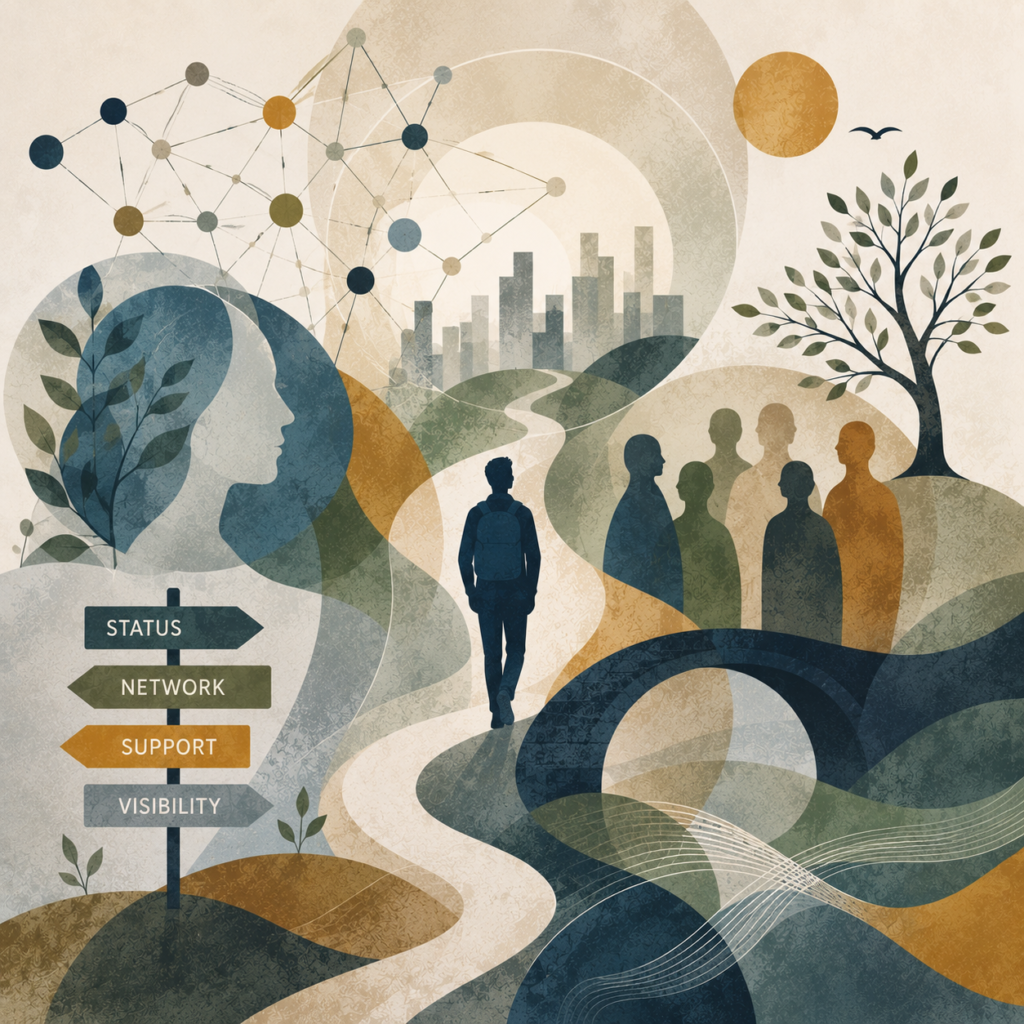
Social Resilience & Migration
This theoretical article reimagines social resilience as a socially constructed, relational, and context-dependent phenomenon grounded in migrants’ lived experiences. Rather than viewing resilience as an individual capacity or ability to overcome adversity, it offers a different way of understanding how resilience is shaped through migrants’ everyday encounters, relationships, and experiences within changing social contexts. The article develops four interconnected dimensions (status, networks, support, and visibility) to show how institutional and social environments influence migrants’ opportunities to adapt, transform, participate, and develop a sense of belonging. Read the full article to explore this alternative conceptualisation of social resilience and its implications for understanding migration and migrants’ lived experiences.
Migrants’ Social Experiences: Social Resilience, Integration and Belonging
These two studies examine migration, social integration, and social resilience in Sweden from complementary perspectives. The first explores migrants’ lived experiences and understandings of integration through the metaphor of a shift from the “melting pot” to the “salad bowl,” highlighting the importance of recognition, social connections, reciprocity, belonging, and migrants’ participation in shaping integration processes. The second turns to the role of grassroots, faith-based initiatives, examining a Church café as an inclusive social space where migrants can build social networks, access information and practical support, practise language, navigate local services, and develop connections beyond religious membership. Together, the studies approach integration not simply as adaptation to a host society, but as a relational and socially constructed process shaped through everyday encounters, support, recognition, participation, and belonging. They highlight how both migrants themselves and local social actors can contribute to creating more inclusive spaces and strengthening migrants’ social resilience and lived experiences of integration.

Young Adult Migrants’ Social Experiences in Sweden: ‘Melting Pot’ and ‘Salad Bowl’ Perspectives on Social Integration
Published in: Children & Society, Wiley Online Library, 2024

The Church’s Café Serving Migrants in Sweden: Creating a Support Network for Social Resilience
Published in: Social Resilience: Critical Responses to Challenges and Change
Vernon Press, 2026

Beyond Formal Integration. Policy Pathways for Belonging and Inclusive Integration
This policy brief explores why formal integration (such as, through employment, education, language skills and legal status) does not always translate into social belonging. Drawing on young migrants’ lived experiences in Sweden, it highlights the importance of recognition, reciprocal relationships, social networking, and everyday spaces such as language cafés, libraries, associations and community initiatives in fostering participation, trust and belonging.
Voices & Perspectives
Commentary and reflections on migration, integration, democracy, religion, multiculturalism and social inclusion, engaging with contemporary debates and questions of belonging, rights, inclusion, and social cohesion.
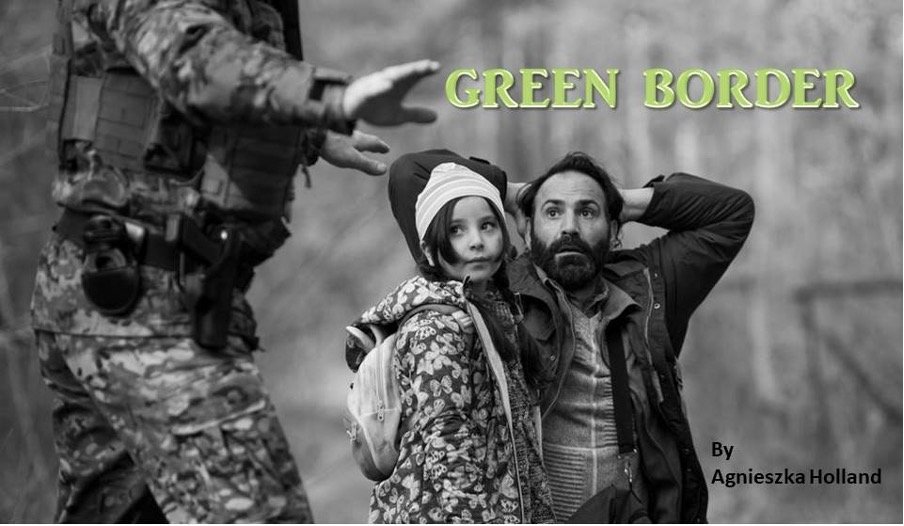
At the Edge of Humanity: Reflections on the Movie Green Border
The movie Green Border engages us deeply with lived realities. It exposes enacted resilience that is a collective course of action to endure and survive while challenging a system marked by inhumanity. In an interview with Swedish Radio, Holland said “It’s a human story, and the most important thing is to give a voice…Read full text

“Islam” and Muslims in the Media.
This article is an English-language adaptation of the original German post “Der Islam und Muslim*innen in den Medien” (July 2024), which appears on the MEDIA SERVICE INTEGRATION website. The purpose of this translation is to make the key findings and resources accessible to a broader international audience. Media …Read full text

Interview with Benedikt Kern from the Ökumenisches Netzwerk Asyl
In this conversation, Benedikt reflects on the grassroots structure of the church asylum network, the moral and political tensions surrounding migration in Germany, and the role of faith-based actors in responding to border violence and restrictive asylum regimes. His insights offer a grounded perspective on solidarity, human rights, and the everyday realities …Read full text

Rethinking Democracy: The Urgent Need for Inclusive and Respectful Discourse
In today’s political climate, where fear and polarization often dominate public discourse, the language used by political leaders matters more than ever. Across Europe and beyond, we are witnessing the rise of parties that present themselves as defenders of democracy and national unity—yet frequently employ… Read full text

Denmark has banned the burning of holy books to protect its multicultural society
January 11, 2024
Amid the debate on freedom of speech and Quran burning, the Danish parliament has legislated to prioritise international relations, internal security, and the best interests of people from various ethnic and religious backgrounds in Denmark.…Read full text

The Tidö Agreement drags Sweden’s social welfare sector into ethical crisis
October 16, 2023
The Swedish government has proposed an obligation that would require public sector workers to notify police and immigration authorities about undocumented migrants. The proposal contradicts professional ethics and human rights.…Read full text

Burning a holy book: the dilemma of free speech
August 18, 2023
Quran-burning incidents can reinforce anti-religious discourses and politicized campaigns against religious minorities. It can also put Swedish multicultural harmony at risk. Laws permitting this must be interpreted in the best interest of the people and their holistic well-being.…Read full text

Mrs Chatterjee vs Norway – An Immigrants Mother’s Fight to Take Her Children Back
May 21, 2023
The movie Mrs Chatterjee vs Norway is a story of an immigrant mother whose two young children were taken away by the Norwegian foster care system and legal machinery, and she fights hard to win back custody the of her children..…Read full text